Buhari’s Body Leaves London For Nigeria

The remains of former President Muhammadu Buhari, on Tuesday morning, departed London, the United Kingdom, for Daura, Katsina State, ahead of a state burial. The body of the late president was conveyed on a Nigerian Air Force craft. Vice President Kashim Shettima is, leading a high-level Federal Government delegation to finalise documentation and logistical arrangements for the repatriation of the ex-president’s remains. On Monday, the federal government said that President Bola Tinubu will receive the former President’s remains in Katsina ahead of his final interment in Daura, Katsina State. The Minister of Information and National Orientation, Mohammed Idris, disclosed this during a press briefing in Abuja. According to Idris, the body of the former president, who died on Sunday in a London hospital, is expected to arrive in Nigeria by noon on Tuesday. “President Bola Ahmed Tinubu, GCFR, will personally receive the remains of the former President in Katsina. “Upon arrival in Katsina, a brief military ceremony will be held at the airport before the body is moved to Daura. “The Jana’iza (funeral prayer) will take place thereafter, followed by interment at the late President’s residence,” Idris said. The minister said as part of national mourning, Tinubu has directed that condolence registers be opened across all Federal Ministries, Departments and Agencies, as well as at Nigerian embassies and missions abroad. He said another register is to be opened at the Bola Ahmed Tinubu International Conference Centre in Abuja. Idris also noted that world leaders have continued to send in condolence messages. “The condolences coming in from Heads of State and Governments across the globe are a testament to the global stature and legacy of President Muhammadu Buhari,” he said. To ensure what he described as a “dignified and well-coordinated programme,” Idris said the President has constituted an Inter-Ministerial Committee chaired by the Secretary to the Government of the Federation, Senator George Akume. The committee will work in collaboration with the Katsina State Government and the Buhari family. The minister further announced that 25 members of the Federal Executive Council have been directed to proceed to Katsina for the burial rites and to remain in Daura for the Third-Day prayers scheduled for Wednesday. Punch

South-West Nigeria At High Risk Of Terror Attacks — Majeobaje Community Development Initiative Raises Alarm •••••Announces Security Workshop

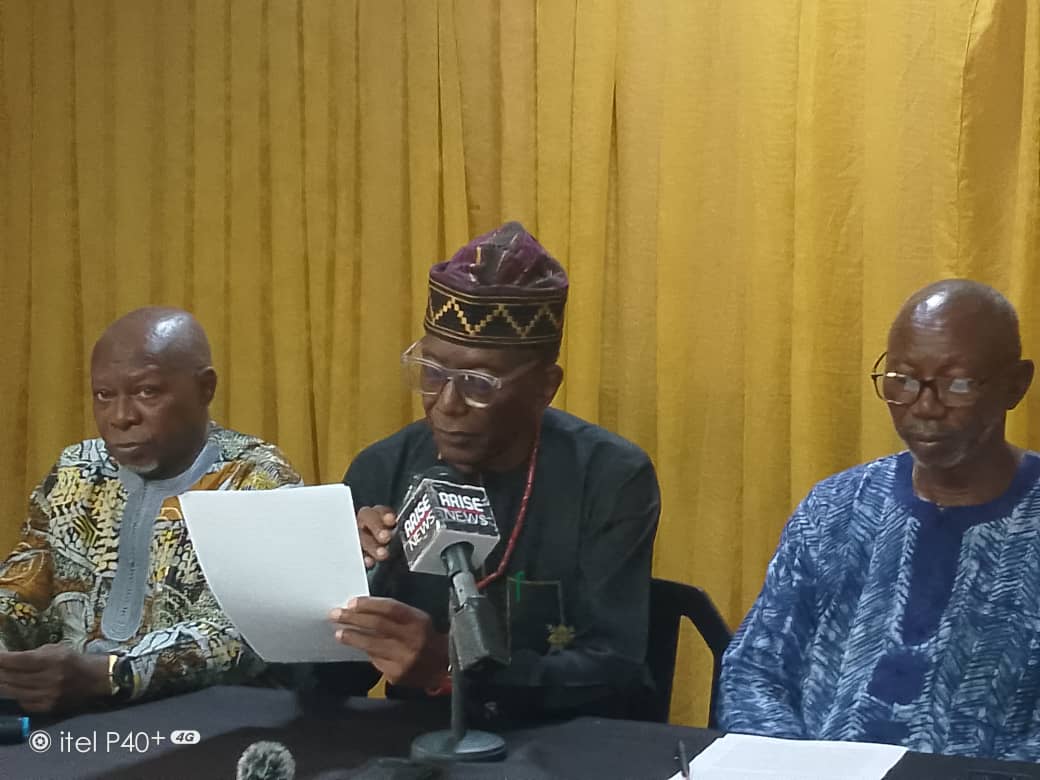
  The Majeobaje Community Development Initiative (Majeobaje CDI) has issued a grave warning over the escalating security threats facing South-West Nigeria, citing a growing risk of terrorist infiltration and calling for immediate, region-led action to safeguard lives and resources. At a press conference held In Bodija Housing Axis, Ibadan on Thursday the civic development organization declared the South-West “at high risk of terrorist attacks” and unveiled plans for a high-level regional security workshop to be held in July. in a well prepared speech read by the Convener of the group, Chief Akintayo Akindeko described the situation as “foreboding and increasingly existential. Chief Akindeko referenced a recent alert by U.S. Marine Corps General Michael Langley, Commander of the U.S. Africa Command, who warned of terrorist plans to access West African coastlines for smuggling, arms dealing, and trafficking. According to Majeobaje, this strategic objective puts states like Lagos and Ondo, both located on Nigeria’s southern coast and home to critical economic infrastructures directly in the terrorists’ crosshairs. “It should be no surprise,” Akin-Deko emphasized, “that this zone would be one of the primary targets of the relentless agents of destabilization. If left unchecked, these incursions will rob our farmers of their land, endanger our livelihoods, and ultimately deny our children their heritage.” The group noted that violent extremism, once largely confined to the Northeast and Middle Belt, has crept into the South-West through Kwara, Kogi, and Edo States, with widespread impacts now felt in Ogun, Oyo, Ekiti, and Ondo. Incidents such as the 2022 St. Francis Church massacre in Owo, and the killings of farmers in Iseyin and Ibarapa were cited as evidence of this growing threat. Majeobaje CDI warned that official neglect and inaction from elected leaders have worsened the situation, stating that “governors, senators, and local government chairmen have largely failed to galvanize community-based security structures, despite having access to enormous resources.” They referenced a May 2025 report indicating that of the ₦7 trillion saved from fuel subsidy removal and distributed among states, little has been visibly invested in security infrastructure. “Even in the 2025 budget, only 1% was allocated to security vehicles — the rest went to ICT, streetlights, and classrooms,” the group lamented. Calling for a shift in priorities, Majeobaje CDI announced plans to convene a 1-Day Sensitization Workshop on Securing Our Communities in early July at the Hall of Chiefs in Ibadan. The event will bring together traditional rulers, policymakers, retired security officers, and grassroots leaders to map out a strategic, legal, and sustainable path toward community-driven security in the South-West. Expected speakers include Professor Olufemi Olufunmilade of the Institute for International Relations and Strategic Studies at Igbinedion University, and retired General Kunle Togun, former Deputy Director General of the State Security Service. In a follow-up session, veteran journalist and civic advocate Dr. Yomi Layinka, also a member of the initiative, clarified the group’s identity and intentions amid rising tensions and political misinterpretations. “We are not a secessionist group,” Layinka stressed. “We are a self-determination group. We are committed to the safety, dignity, and development of the Yoruba people within the framework of a just and secure Nigeria.” He added that while Majeobaje CDI supports “the good policies of the current administration,” they “will not hesitate to speak truth to power when the government goes wrong.” Concluding the conference, Chief Akin-Deko issued a stern reminder to South-West leaders: “We are not asking you to become Security Agents. But we are demanding that you prioritize security. Stop sleeping. Start leading. The time to act is now.” The press conference was attended by journalists, community leaders, civil society representatives, and members of the public.

Eid-El-Kabir: Makinde Charges Muslim To Engage More Prayers For Oyo State, Nigeria

  As Muslims around the world observe the Eid-el-Kabir festival, the Governor of Oyo State, Engr. Seyi Makinde, has felicitated the Muslim Ummah in the state. According to the statement by the Special Adviser to the Governor on Media, Dr Sulaimon Olanrewaju, the governor charged them to use the occasion of the blessed festival to engage in more prayers for the state, Nigeria and all the leaders. ‎Governor Makinde, who said that the Eid Adha is one blessed and glorious festival through which Muslims worship God and show complete dedication to him, prayed to God to accept and reward the sacrifices of all worshippers. He appreciated the Muslim Ummah for their unrelenting support for his administration and their constant prayers, stating that he remained assured of their support and prayers as the administration begins its seventh year in office. “I want to congratulate my Muslim brothers and sisters in Oyo State and across the world on witnessing the Eid-el-Kabir 2025. ‎“The Eid Adha is one glorious festival and an opportunity for Muslim faithful to demonstrate their dedication to God through prayers and sacrifice. “While congratulating them on the occasion of Eid-el-Kabir, I also appreciate the Muslim community in Oyo State for their unrelenting support, prayers and sacrifice for the betterment of our state. “I admonish them to continue to pray for their government, which has served them for six years and delivered accelerated and sustainable development and to continue to support us. ‎“Let me also add that our government, their government, will continue to put the interests of the people of the state first. “Again, I urge all Muslims and all residents of the state to be watchful and alert during the festivities, as security is a responsibility for everyone. If anyone sees something, they should say something and the government will do something. “Barka de Sallah.”

JP Morgan Eyes Opening Full Business Branch In Nigeria

  American Bank, JP Morgan, is planning to transform its representative office in Lagos into a fully-fledged business branch. According to a report on Africa Intelligence, the move is in line with its Chief Executive Officer, Jamie Dimon’s strategy to strengthen its presence in Africa. From its Lagos office, JP Morgan provides clients with products and services from across our Asset & Wealth Management and Commercial & Investment Bank lines of business. Last year, JP Morgan opened representative offices in Kenya and Côte d’Ivoire as part of an effort to expand in East and West Africa. During his trip to Nigeria last October, Dimon said that he had plans to expand into Africa after the 2008 financial crash, but that he had been prevented from doing so by the US government. “They said banks were risky and didn’t want to add any risks. They were wrong,” he said. Back in 2018, JPMorgan also tried to secure licences to offer banking services in Ghana and Kenya, without success. Regarding the latest development, Africa Intelligence said that JP Morgan managed in Nigeria by Dapo Olagunju will apply to the Central Bank of Nigeria for a merchant banking licence in the coming months. If successful, this new US-Nigeria entity will be able to offer FX-denominated loans to large companies in addition to its advisory and asset management activities. During Dimon’s visit, he met the CBN Governor, Olayemi Cardoso and attended the 30th anniversary of the Nigerian Economic Summit Group, where he shared insight on global markets, financial innovation, and what it takes to drive sustainable economic growth in Nigeria and beyond. He also visited South Africa, where JP Morgan has a subsidiary and Kenya. Before the trip, Dimon stressed that he wanted to strengthen the bank’s presence in Africa by adding a country or two every couple of years or so. Punch

Minister Of Education Advocates 12-Year Basic Education In Nigeria 

  The Minister of Education, Dr. Tunji Alausa has proposed a shift to a 12-year basic education model in Nigeria. Alausa made the proposal on Thursday, in Abuja, at the 2025 Extraordinary National Council of Education meeting, which is the highest education policy-making body in Nigeria. Nigeria currently operates the 9-3-4 system, which consists of nine years of basic education, three years of senior secondary education, and four years of tertiary education. However, Alausa pointed out that some of the issues influencing the convening of the extraordinary National Council of Education meeting include the introduction of a 12-year basic education system in Nigeria’s education framework and the approval of a national policy on bullying, among others. “It is important to acknowledge that while the 9-3-4 system of education has its merits, it also has drawbacks, such as the need for students to work to further their education,” Alausa explained. “It is therefore prudent to transition from the 9-3-4 to the 12-4 system of education. By doing so, Nigeria will align with global standards in preparing students for better tertiary education.” “A 12-year basic education model will ensure a continuous, uninterrupted curriculum, promoting better standardisation and fostering quality assurance in the education system,” Alausa said. He argued that a 12-year model will also guarantee that students receive a more comprehensive and continuous learning experience. This, he said, would improve educational outcomes and contribute to a more educated populace that drives Nigeria’s economic development. He also mentioned the planned conversion of federal science and technical colleges into federal technical colleges. The minister emphasised that technical education, which imparts practical and applied skills alongside basic scientific knowledge, is crucial for addressing the current skills gap in the labour market. “The provision of technical education allows a nation’s human and natural resources to be harnessed more effectively. Therefore, technical education contributes significantly to national development, driving cultural and industrial progress,” Alausa noted. He also mentioned that the council was looking at the 16-year policy on admission into tertiary institutions, to be incorporated into the national policy on education. “I am sure many of you have heard about the challenges we face as a nation with talented, bright students being disenfranchised from pursuing tertiary education. In any society, it is crucial to standardise the education of highly functional and exceptionally gifted students. “We are now preventing these students, after finishing secondary education at the age of 16, from attending university until they are 18. This delays their development and harms their futures. These students are capable and brave. If we leave them idle, we risk exacerbating mental health issues,” he said.

Tinubu Affirms Nigeria’s Commitment To Improved Electricity

  President Bola Tinubu has reaffirmed Nigeria’s commitment to providing reliable, affordable, and sustainable electricity to its citizens by 2030. Tinubu made the declaration as he concluded his participation in the Mission 300 Africa Energy Summit held in Dar es Salaam, Tanzania, where he joined other African leaders to address the continent’s energy access challenges. This was disclosed in a statement by the Special Adviser to the President (Information and Strategy), Bayo Onanuga, on Tuesday. The two-day summit, hosted by the Tanzanian government in collaboration with the African Union, African Development Bank, and the World Bank Group, culminated in the adoption of the Dar es Salaam Declaration. The declaration sets a collective target for African nations to provide electricity to 300 million people by 2030. In his speech, delivered by the Minister of Power, Adebayo Adelabu, Tinubu expressed Nigeria’s commitment to this goal, stressing that energy access would remain a top priority for his administration. He called for a united, collaborative effort among African nations, development partners, and private sector stakeholders to ensure that all Africans have access to electricity in the next decade. “Let us work together to create a brighter future for our citizens, where every African has access to reliable and affordable energy, where our industries thrive, and our economies grow,” Tinubu said. The President seized the opportunity to highlight the strides Nigeria has made in improving its energy access, with the support of international partners. He outlined several ongoing projects, including the $1.1 billion investment by AfDB that will provide electricity to 5 million Nigerians by 2026. He also noted the $200 million Nigeria Electrification Project, aimed at electrifying 500,000 people by the end of 2025, and the planned investments in the Nigeria Desert to Power programme and the Nigeria-Grid Battery Energy Storage System. “These initiatives represent our commitment to improving electricity access for our citizens, especially those in underserved areas. We are making tangible progress towards achieving our goal of providing electricity for all by 2030,” Tinubu said. The President also emphasized Nigeria’s push towards renewable energy, highlighting the government’s efforts to establish an electric vehicle charging infrastructure powered by renewable energy. This move, he said, is part of Nigeria’s broader commitment to sustainable energy solutions and reducing reliance on fossil fuels. “Nigeria’s energy sector is growing, and we are incentivizing private sector investments to expand renewable energy, improve energy efficiency, and bring electricity to those who need it the most,” he said. Tinubu also underscored the importance of regional cooperation in achieving the energy access goal. He pointed to the collaboration between the Nigerian government and key international development partners like AfDB, the World Bank, and the IFC, which have committed billions in funding for energy projects in Nigeria. Punch

Medical Experts Warn Of Rising Costs, Scarcity Of Diabetes Medications In Nigeria

  Medical experts have raised concerns over the soaring costs and scarcity of diabetes medications in Nigeria. They also revealed that the number of individuals living with diabetes in the country has risen to approximately 14 million. Marking World Diabetes Day, themed “Breaking Barriers, Bridging Gaps”, the experts stressed the urgent need for action. Speaking to our correspondent, Consultant Physician and Diabetologist, and First Vice President of the Diabetes Association of Nigeria, Dr Mansur Ramalan, lamented the escalating drug costs and their unavailability. “Diabetic patients are suffering from both the high cost and unavailability of drugs because three major companies marketing these drugs, including Sanofi Aventis, a major insulin producer, have exited the country. “These drugs are now sold through third parties, which has naturally led to price increases. Furthermore, due to the exchange rate challenges, prices have skyrocketed. This has created problems of affordability, availability, and accessibility for patients,” he stated. Dr Ramalan urged the government to intervene, highlighting the plight of diabetes patients. “This year, the association wrote to the government about the cost of drugs, but no action was taken. Last week, we heard about free caesarean sections for women; if that can be done, similar measures can address our concerns. “Currently, Nigeria has a diabetes prevalence rate of 4 to 6 per cent, equating to an estimated 12 to 14 million people living with diabetes. This figure is rising yearly. In 1991, the prevalence rate was 2.4 per cent, but it has since surged to approximately 5.7 to 6 per cent,” he added. Professor Tanimola Akande, a Public Health expert at the University of Ilorin and former National Chairman of the Association of Public Health Physicians of Nigeria, corroborated these concerns. “Diabetes is a chronic non-communicable disease with a high prevalence and burden in Nigeria. World Diabetes Day provides an opportunity to raise awareness and offer screening for the population. It also allows governments and stakeholders to prioritise activities and programmes that address diabetes prevention and control,” he said. The World Health Organisation’s Regional Director for Africa, Dr Matshidiso Moeti, warned last Thursday that the number of people living with diabetes in Africa is projected to rise to 54 million by 2045, marking the highest predicted increase globally if urgent action is not taken. Dr Moeti noted, “In the WHO African Region alone, more than 24 million adults currently live with diabetes, half of whom remain undiagnosed. Left untreated, diabetes can lead to complications such as heart disease, stroke, nerve damage, kidney failure, lower-limb amputation, and blindness. “Without urgent interventions, the number of people living with diabetes in the region will rise to 54 million by 2045, posing a dual health and economic burden, including catastrophic individual spending to manage the disease. “Africa also has the lowest investment rate in diabetes care globally, with only 1 per cent of health expenditure dedicated to it. Health systems traditionally designed to address acute infectious diseases lack sufficient focus on chronic conditions like diabetes.” Dr Moeti urged governments and stakeholders to act promptly, emphasising the need for proper nutrition, access to essential medicines, physical activity, mental health support, and community engagement to combat diabetes effectively. She concluded, “Strengthening diabetes control in Africa requires addressing key gaps, including myths and misconceptions, fragile primary health care systems, and insufficient capacity and training of health care workers.”   Punch

Binance Executive Gambaryan Leaves Nigeria After Eight Months Of Detention.

  The world’s biggest cryptocurrency exchange made the disclosure in a statement shared with The PUNCH on Thursday. “Today, American citizen Tigran Gambaryan left Nigeria to return home to his family after eight months of unlawful detention. “Gambaryan was allowed to leave Kuje prison last night. His health has suffered significantly while in prison. He will now be able to finally receive the medical attention he desperately requires,” the exchange said. The development followed a ruling by the Federal High Court in Abuja, on Wednesday, which dismissed the money laundering charges brought against Gambaryan by the Economic and Financial Crimes Commission. During the court session, the EFCC explained that the case could not proceed at the last adjourned date due to Gambaryan’s declining health. A review by the Nigerian Correctional Service, supported by the Office of the National Security Adviser, indicated that Gambaryan’s condition had worsened to the extent that he could hardly walk without the aid of a wheelchair. The development followed a ruling by the Federal High Court in Abuja, on Wednesday, which dismissed the money laundering charges brought against Gambaryan by the Economic and Financial Crimes Commission. During the court session, the EFCC explained that the case could not proceed at the last adjourned date due to Gambaryan’s declining health. A review by the Nigerian Correctional Service, supported by the Office of the National Security Adviser, indicated that Gambaryan’s condition had worsened to the extent that he could hardly walk without the aid of a wheelchair. Binance prosecution continues as court frees executive on health grounds FG drops money laundering charges against Binance executive Gambaryan Court adjourns Binance executive Gambaryan trial till October 25 Reacting to the development, Gambaryan’s wife, Yuki, expressed her relief at his release. “It is a huge relief that this day has finally come. The past eight months have been a living nightmare. I wish it hadn’t taken this long for his release or that his health had not declined so much, but we can now focus on healing as a family. “I want to express my deepest gratitude to the US government for their efforts in securing his release. I also want to thank everyone who helped us throughout this ordeal. There were moments I feared this day would never come, but Tigran’s supporters gave me hope and strength. “The road ahead for Tigran’s recovery is going to be difficult, and I appreciate being given the time and space to focus on that. Our children cannot wait to see their dad again,” she stated. In February, Nigerian authorities detained Gambaryan and his colleague, Nadeem Anjarwalla, a 37-year-old British-Kenyan who serves as the regional manager for Africa at Binance. Both were charged with money laundering involving $35m, as initiated by the anti-graft agency. While Anjarwalla managed to escape custody on March 22, 2024, Gambaryan was arraigned in court on April 8.  

CAF Pulls Out Nigeria, Libya AFCON Qualifier Amidst Controversy

  The Confederation of African Football has delisted the Group D second-leg fixture of the ongoing 2025 African Cup of Nations qualifier between the Super Eagles of Nigeria and the Mediterranean Knights of Libya. The game was earlier scheduled to take place in Libya by 8 pm after the first leg took place in Godswill Akpabio Stadium, Uyo on Friday. The Super Eagles beat the Mediterranean Knights by a lone goal in the dying minute of the game. However, the return leg has been greeted with controversy after the Super Eagles players and officials narrated their over 14 hours ordeal at the Libya airport leading them to return home. Meanwhile, CAF said it had launched an investigation into the incident after the Libya Football Federation alleged sabotage and threatened legal action against Nigeria. The African football body further updated games that would be played on Tuesday without including the Libya versus Nigeria game on its X handle.

Wike’s Nigeria Feeds Citizens’ Bodies To Pigs By Festus Adedayo

  Nigerians and indeed, the world, watched aghast last week as a South African grisly movie reel began to roll. Full of all the elements of a movie, it was however a real story. The cast was two black women who, on August 17, were shot and fed to pigs by a white farmer. The victims, Maria Makgato, 45 and Lucia Ndlovu, 34 were scavenging for edible food in consignments of recently expired or soon-to-be-expired produce on a farm located near Polokwane, a South African northern Limpopo province. The expired edible foods were meant for pigs. Before her gruesome murder, Makgato was mother of four sons of between 22 and five years ages. Farm owner, Zachariah Johannes Olivier, 60, had reportedly ordered his employees, Adrian de Wet, 19, and William Musora, 50, to kill the two women. Their bodies were then fed to pigs, in order to destroy evidence of their murder. Ms Ndlovu’s husband, Mabutho Ncube, who came to the farm with his wife, had been shot, too but crawled into safety with his gunshot wounds. Several days later, police found decomposing, horrific bodies of the women in the farm’s pigsty, partly eaten up by the swine In South Africa, farming communities are severally under attacks by white farmers, exacerbating an already high crime statistics in the country. This is especially rife in rural areas, despite the official cessation of the obnoxious racist system of apartheid 30 years ago. In same August, in the eastern province of Mpumalanga, two men – a farmer and his security guard – were arrested in Laersdrift, located beside a small South African town called Middleburg, for allegedly murdering two men on a farm. Accused of stealing sheep, the men were incinerated beyond recognition. The court had to subject their ashes to DNA analysis to be able to establish their identities. In the same vein, a 70-year old white farmer, Christoffel Stoman, of Lutzville, a Western Cape province, had allegedly driven over and broken the two legs of a 6-year old boy for picking a fallen orange on his farm. The boy’s mother, walking with him past Stoman’s farm, on their way to town to purchase groceries, was horrified as his son got mowed down by Stoman. As they watch this grisly movie, like the rest of the world, Nigerians are entitled to their shock. However, literally and figuratively, on the social and political planes, our country can be said to be grappling with leaders of similar sadism as South Africa’s Oliviers. Almost on a daily basis, Nigerians’ bodies are figuratively fed to swine, simply because they pick expired pig foods from our collective farm. Nigerian leadership in the last seventeen months, like Olivier, has figuratively thrown Nigerians’ bodies to the swine who now take turns to feast on our flesh for supper. Nigerians are writhing under excruciating poverty occasioned by wickedness in high places. They encounter limited vision and foresight of leaders who claimed it was their time to rule but who have no time to think through the people’s plights. Perhaps the greatest Olivier-like savagery inflicted on Nigerians is the gradual destruction and undermining of the foundation of democracy by the born-to-rule taskmasters. In almost 17 months, all the institutions of democracy, like the electoral system, free press/speech and impartial judicial system have been dealt mortal blows. They are all comatose today. This speaks to that eternal aphorism that democracies are not killed by guns but by wicked undermining of its foundation. If Nigerians are so distressed about the misrule in their country today, unfortunately, they are in a Catch-24 situation. We are locked up in a paradoxical situation from which, except an intervention of providence, we may never escape. As Sule Lamido warned recently, if the Leviathan in Aso Rock didn’t control the Senate, the Nigerian Army, Nigerian police, DSS etc and yet won the 2023 election, it is wishful thinking that anyone can stop the reproduction of this misrule in 2027. The ones at the top today have worn upon them the classical head of the Medusa. In real terms, like the sobriquet of one of the friends of Ayinla Omowura, an Abeokuta musical warlord of the 1970s, they are reincarnates of Ab’esuj’obi – one who shares kolanut with the devil. According to the playbook of democracy, opposition deepens democracy. In Nigeria, the Leviathan has effectively castrated opposition. And this is why we should all be bothered. It is a Lagos model given federal promotion. The Leviathan then dipped his hands into his wiles pouch. From there, he brought out a colony of termites, led by a choleric dictator who is seeking political vengeance in his home state. His main assignment was to gradually corrode virtually all the internal strength of the PDP. I will not be shocked if the Leviathan is also the sponsor of the crisis in the Labour Party as well. Like a colony of pests called termites, Aso Rock and Nyesom Wike have visited on our country, using Rivers State as model, one of the most debilitating democratic devastations ever in history. This means that, whatever tyranny and limited vision leadership which Nigerians complain of today has a longer expiry period than they may think. We should all buckle up for a marathon. It is a distressing reality. What happened in Edo State last month, coupled with the lawlessness that has eaten up Rivers State today, are clear signals that the electoral, judicial and police institutions have been ambushed. In broad daylight, with the obvious abetment of the Villa, electoral process was cavalierly thrown to the swine. The animals in turn mauled it with maniacal relish. It was obvious that Mahmood Yakubu’s INEC didn’t have any qualm licking the pus-dripping wound of the Leviathan and his accomplices. With wanton abuse of electoral rules by INEC, advocacy for the abrogation of state electoral commissions for being lapels of state governors will not make any sense. From what is going on in Rivers today, with INEC openly … Read more