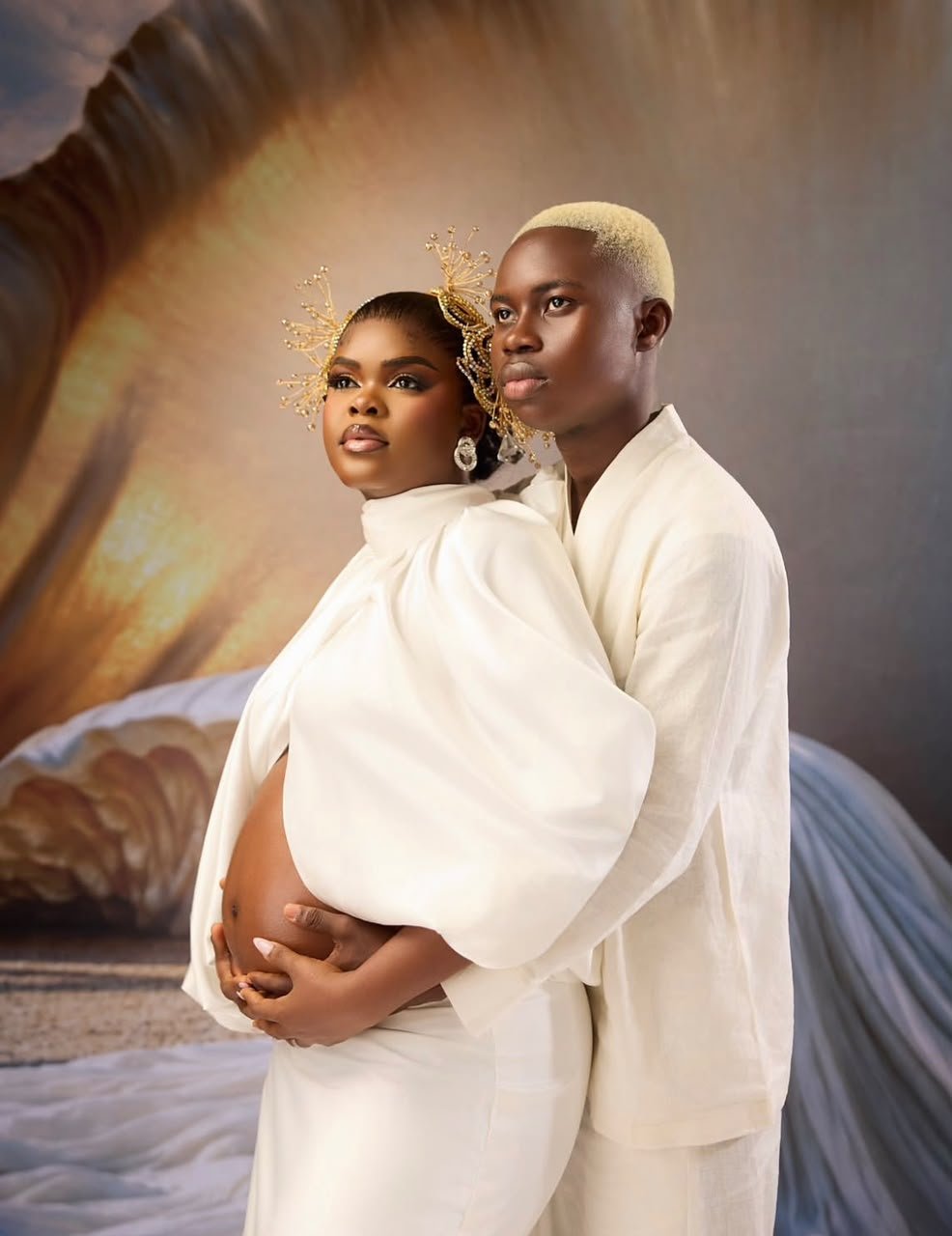
PHOTOS: Peller, Jarvis Expect First Child, Call It Their ‘Answered Prayer’

  Popular TikTok stars Habeeb Adelaja, better known as Peller, and his wife, Amadou Aminata, popularly known as Jarvis, are expecting their first child. The couple announced the news on Thursday through their Instagram pages, sharing beautiful photos from their pregnancy shoot. Sharing her excitement, Jarvis described the pregnancy as their “greatest blessing” and “answered prayer.” She wrote, “From two people who once had no idea where this journey would take us… to husband and wife, and now soon-to-be parents.” “We’ve laughed, we’ve cried, we’ve prayed, we’ve grown, and through it all, God kept writing our story.” She added, “A little piece of our love is coming into this world. Our greatest blessing. Our answered prayer.” The announcement has sparked congratulatory messages from celebrities, influencers and fans, with many wishing the couple a safe pregnancy and delivery. Influencer and content creator Tomike Adeoye wrote, “Congratulations Mummy and Daddy,” while Folagade Banks commented, “Congratulations My Darlings!! Asokale Ayo!” The pregnancy announcement comes months after Peller and Jarvis held a lavish, star-studded wedding ceremony in Lagos.

Foundation Sues TikTok Over Alleged Restrictions in Kano, Kaduna, Kebbi, Sokoto

The Foundation for Digital Justice has sued TikTok Inc. at the Federal High Court in Abuja over alleged restrictions on access to the platform in Kaduna, Kano, Kebbi and Sokoto states. The organisation is asking the court to order TikTok to restore access to millions of users in the affected states. The suit was filed on October 5, 2026, by the Foundation’s lead counsel, Festus Ogun. It was brought under the Fundamental Rights Enforcement Procedure Rules, 2009. The Foundation alleged that the restrictions violated Nigerians’ constitutional rights to freedom of expression and freedom from discrimination. Users Report Access Problems In an affidavit filed in support of the suit, the Foundation’s legal officer, Abidat Idowu, said users in the four states began experiencing difficulties accessing TikTok around September 11. By September 14, she said, access to the platform had become “completely restricted and inaccessible to millions of Nigerian Users in Kaduna, Kano, Kebbi and Sokoto States.” According to the affidavit, users on regular mobile data connections were affected. Their feeds were reportedly freezing, while videos failed to load and uploads repeatedly stalled. “These users cannot load videos, refresh their feeds and upload content on TikTok,” Idowu stated. The Foundation further alleged that the disruption had prevented affected users from accessing and sharing information or participating in online discussions. “Millions of Nigerian Users in Kaduna, Kano, Kebbi and Sokoto States are left out of access to information, they cannot disseminate information, they cannot receive information and cannot express their opinions on the Respondent’s TikTok’s platform owing to the restriction and/or disruption,” the affidavit stated. Foundation Alleges Discrimination The organisation said some affected users had been able to regain access by using virtual private networks, commonly known as VPNs. It also alleged that TikTok remained fully accessible to users in other parts of Nigeria. “Disturbingly, except in Kaduna, Kano, Kebbi and Sokoto States, users in all other parts of Nigeria continue to enjoy unrestricted and unfettered access and usage of Respondent’s TikTok App,” Idowu stated. The Foundation argued that TikTok had not provided an explanation for the alleged difference in access. “The Respondent has also not provided any explanation for the obvious exclusion, discrimination and restriction of access against all TikTok users in Kaduna, Kano, Kebbi and Sokoto States,” the affidavit said. The organisation wants the court to determine whether the alleged restriction violates Section 39 of the 1999 Constitution, which protects freedom of expression, as well as Article 9 of the African Charter on Human and Peoples’ Rights. It is also asking the court to determine whether the alleged differential treatment violates Section 42 of the Constitution and Article 2 of the African Charter, which protect against discrimination. TikTok Access Described as Critical The Foundation argued that TikTok has become more than an entertainment platform in Nigeria. According to the organisation, the platform is widely used for communication, journalism, business, civic participation, and political and social discourse. “The Respondent’s platform is very critical for communication, journalism, civic participation, business, political and social discourse in Nigeria and the restriction of millions of TikTok users in Kaduna, Kano, Kebbi and Sokoto States has unduly excluded them,” it said. The Foundation also argued that activities such as posting, liking, reposting and replying to content constitute forms of expression. It stated that users affected by the alleged restriction were prevented from viewing, posting, replying to, reposting or liking content on TikTok. The organisation therefore described the alleged restrictions as an exclusion of residents of the four states from what it termed a public forum. What the Foundation Wants The Foundation is seeking several orders from the court. It wants the alleged restrictions to be declared “wrongful, unconstitutional, arbitrary” and a violation of the right to freedom of expression. It is also asking the court to declare that restricting users in the four states while allowing access elsewhere in Nigeria amounts to discrimination. In addition, the organisation wants TikTok to immediately restore access to affected users. It is seeking a perpetual injunction preventing the company from imposing similar restrictions on users in the affected states, or elsewhere in Nigeria, without lawful justification. The Foundation is also asking the court to order TikTok to publish a public apology in three national newspapers within seven days of judgment. It said the legal action was necessary to protect digital rights and uphold the rule of law. “This lawsuit is imperative for the enforcement of fundamental rights to freedom of expression and freedom from discrimination and preservation of the rule of law,” the affidavit stated. The Foundation further argued that unless the reliefs sought were granted, the alleged violations would continue to affect millions of TikTok users in the four states.
Trump Extends Deadline For TikTok Sale By 90 Days

  President Donald Trump announced on Thursday that he had given social media platform, TikTok another 90 days to find a non-Chinese buyer or be banned in the United States. “I’ve just signed the Executive Order extending the deadline for the TikTok closing for 90 days (September 17, 2025),” Trump posted on his Truth Social platform, putting off the ban for the third time. A federal law requiring TikTok’s sale or ban on national security grounds was due to take effect the day before Trump’s January inauguration. The Republican, whose 2024 election campaign relied heavily on social media, has previously said he is fond of the video-sharing app. “I have a little warm spot in my heart for TikTok,” Trump said in an NBC News interview in early May. “If it needs an extension, I would be willing to give it an extension.” TikTok on Thursday welcomed Trump’s decision. “We are grateful for President Trump’s leadership and support in ensuring that TikTok continues to be available for more than 170 million American users,” said a statement issued by the platform. – Digital Cold War? – Trump said in May that a group of purchasers was ready to pay TikTok owner ByteDance “a lot of money” for the video-clip-sharing sensation’s US operations. Trump has repeatedly downplayed risks that TikTok is in danger, saying he remains confident of finding a buyer for the app’s US business. The White House had announced Monday that Trump would throw the wildly popular video-sharing app, which has almost two billion global users, another lifeline. During this new grace period the administration will work “to ensure this deal is closed so that the American people can continue to use TikTok with the assurance that their data is safe and secure,” the administration said in a statement. The president is “just not motivated to do anything about TikTok,” said independent analyst Rob Enderle. “Unless they get on his bad side, TikTok is probably going to be in pretty good shape.” Trump had long supported a ban or divestment, but reversed his position and vowed to defend the platform after coming to believe it helped him win young voters’ support in the November election. Motivated by national security fears and a belief in Washington that TikTok is controlled by the Chinese government, the ban took effect on January 19, one day before Trump’s inauguration, with ByteDance having made no attempt to find a suitor. TikTok “has become a symbol of the US-China tech rivalry; a flashpoint in the new Cold War for digital control,” said Shweta Singh, an assistant professor of information systems at Warwick Business School in Britain. The president announced an initial 75-day delay of the ban upon taking office. A second extension pushed the deadline to June 19. Now the deadline is September 17. – Tariff turmoil – Trump said in April that China would have agreed to a deal on the sale of TikTok if it were not for a dispute over his tariffs on Beijing. ByteDance has confirmed talks with the US government, saying key matters needed to be resolved and that any deal would be “subject to approval under Chinese law.” Possible solutions reportedly include seeing existing US investors in ByteDance roll over their stakes into a new independent global TikTok company. Additional US investors, including Oracle and private equity firm Blackstone, would be brought on to reduce ByteDance’s share in the new TikTok. Much of TikTok’s US activity is already housed on Oracle servers, and the company’s chairman, Larry Ellison, is a longtime Trump ally. Uncertainty remains, particularly over what would happen to TikTok’s valuable algorithm. “TikTok without its algorithm is like Harry Potter without his wand — it’s simply not as powerful,” said Forrester Principal Analyst Kelsey Chickering. Despite the turmoil, TikTok has continued with business as usual. The platform on Monday introduced a new “Symphony” suite of generative artificial intelligence tools for advertisers to turn words or photos into video snippets for the platform. AFP